
 French
 English
We developed quantitative methods to investigate bone at the cellular scale and image the lacuno canalicular network (LCN) from X-ray micro-CT images at the submicrometer scale [Dong-2014-Bone]. By using, X-ray phase nano-CT, we were able to show evidence for the role of the osteocytes in mineralization of bone tissue by measuring the influence of the LCN morphology on the mass density distribution [Hesse-2015-JBMR]. The exquisite 3D images of bone tissue at the cellular scale further permitted to study the role of the LCN for mechanosensation by simulating strain in the bone tissue and the cells using FEM [Varga-2015-BMMB].
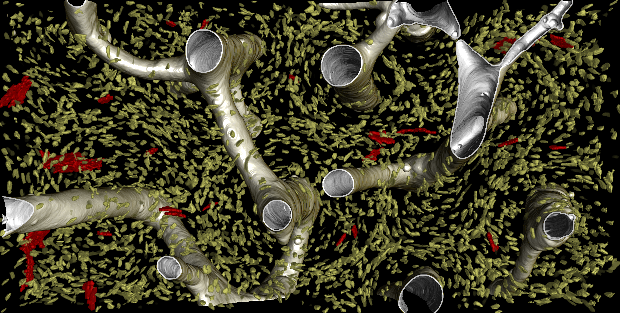
Synchrotron CT imaging was also used in the context of the ANR project MULTIPS to evaluated multi physics properties of bone (ultrasound, biomechanics, chemistry and imaging). In the PhD of Boliang Yu, in an effort to quantify and resolve some of the artifacts still present in the nano-CT images, we evaluated the use of different phase retrieval algorithms in terms of image quality in bone imaging at the cellular scale [Yu-2018- Optics Express]. Ongoing works concern the quantitative analysis of the bone cellular network from such images. In parallel, the tenacity and microstructure of cortical bone have been analyzed in the PhD of R Gauthier in collaboration with LBMC (D Mitton). This study allowed to quantify the osteocyte lacunae and micro cracks after a three-points bending test at different sites (radius, femoral neck and diaphysis) (see figure) [Gauthier-2017-JMBBM] [Gauthier-2018-Journal of Structural Biology] [Gauthier-2019-J Biomech] [Gauthier-2019-J Biomech].
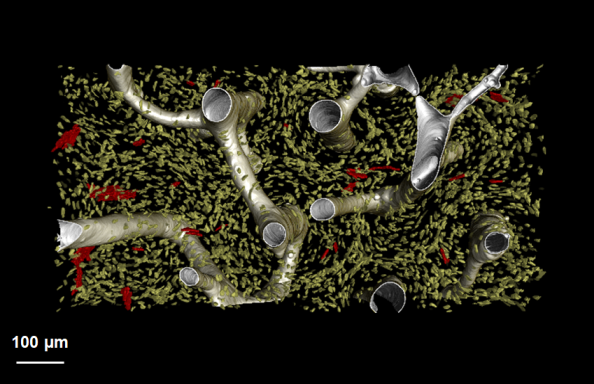
The vascularization of bone is important in several processes and pathologies. In 2014, in collaboration with M. H. Lafage-Proust (INSERM UMR_S 1059) and Ph. Clézardin (UMR_S 1033) we were awarded a CLARA Oncostarter grant to study the role of vascularization in breast cancer bone metastasis. This allowed, in conjunction with a successful bid for beam time at the ESRF to acquire a large series of images. This work is being continued in the PhD of Hao Xu (China Scholarship Council (CSC) grant).