
 French
 English
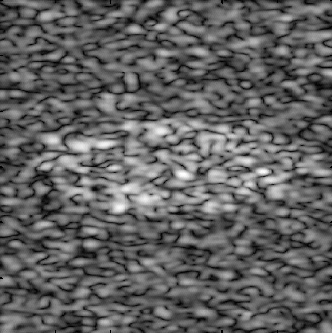
Data simulation is an important research tool to evaluate algorithms. Two types of methods are currently used to simulate medical ultrasound data: those based on acoustic models and those based on convolution models. The simulation of ultrasound data sequences is very time-consuming. In addition, many applications require accounting for the out-of-plane motion induced by the 3-D displacement of scatterers. Thus, we propose a model adapted to a fast simulation of ultrasonic data sequences with 3-D moving scatterers based on the convolution model. In order to reduce CPU time, we use a weighted projection before a 2D convolution instead of a 3D convolution.
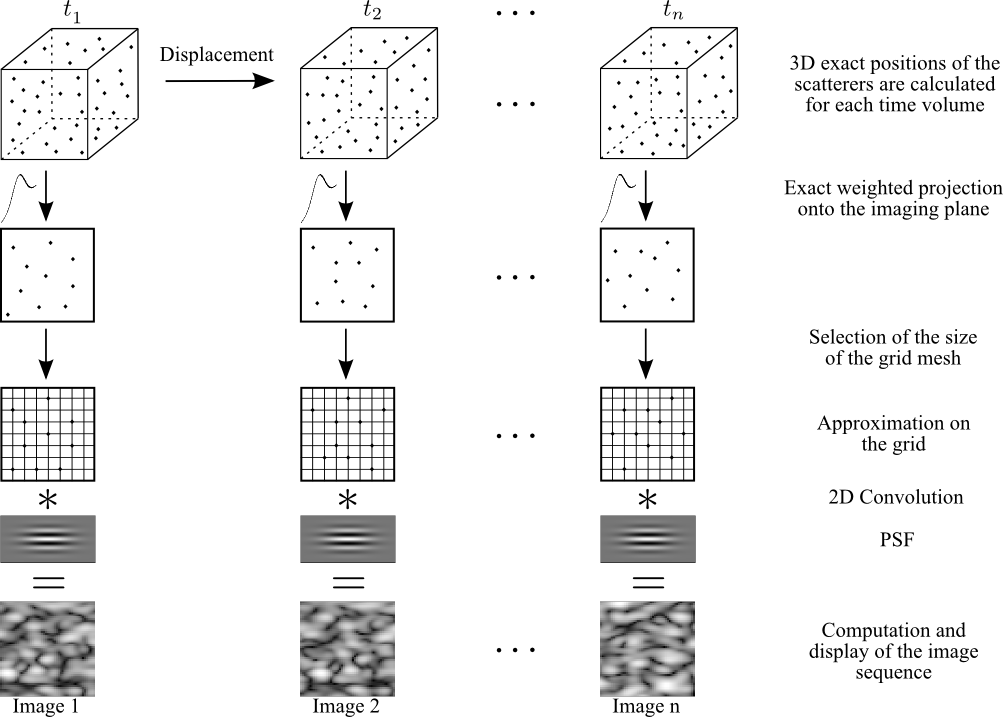
The simulation algorithm can be summarized in 4 steps:
- the scatterers are moved within a 3-D continuous medium between each pair of images;
- the scatterers included in the azimuthal width of the PSF are exactly projected onto the imaging plane $z=k$;
- each projected scatterers is approximated to the closest node of a sampled grid;
- and finally the RF image is formed from the numerical convolution between weighted nodes of the grid and the PSF
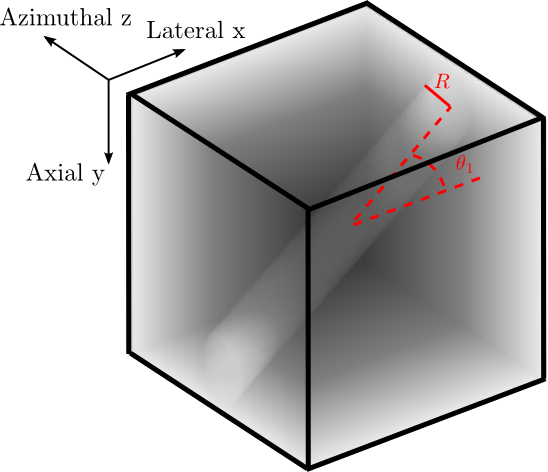
The simulation model requires successive 3-D positions of scatterers to simulate sequences of images. These positions are provided by a displacement model related to the application to develop. Here we propose a displacement model applied to flow imaging, which simulate a paraboloid flow within a cylinder. The parameters are:
- $\theta_1$: vessel orientation within the imaging plane
- $\theta_2$: out-of-plane vessel orientation
- $R$: vessel radius
- $v_{mean}$: mean velocity
Let us note that the amplitude between moving and stationary scatterers (inside and outside the vessel) is tunable and so the vessel can appear more or less dark.
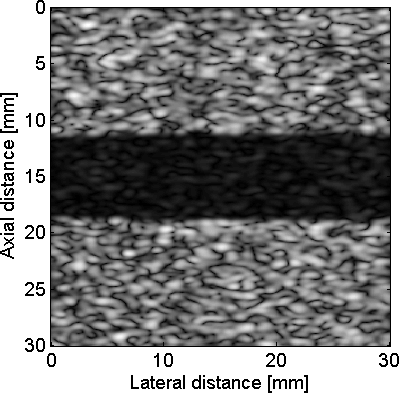
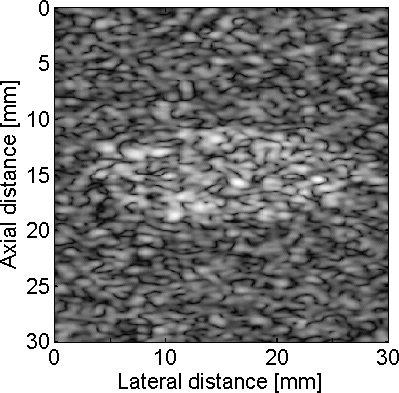
A large set of data can be simulated with our framework. These are some results obtained with the simulation algorithm coupled with the flow motion model. a) is a longitudinal flow with amplitude ratio equal to -20dB; b) is an out-of-plane flow with amplitude ratio equal to 6dB; c) is an oriented flow with amplitude ratio equal to 6dB. A colour velocity map obtained from a well-known speckle-tracking algorithm is superimposed on c)
 |
 |
 |
| a) $\theta_1$=0° $\theta_2$=5° $R$=8 mm | b) $\theta_1$=0° $\theta_2$=20° $R$=8 mm | c) $\theta_1$=20° $\theta_2$=5° $R$=8 mm |
Below, you can see a movie of a pulsatile flow.