
 French
 English
Micro-robotic particles (micrometre-scale particles that can be remotely actuated, typically using magnetic fields) are an emerging technology offering new perspectives for biomedical applications, particularly targeted therapy and microsurgery [1], [2]. However, their very small size makes their instrumentation and precise control challenging. Ultrasound is a particularly attractive modality for tracking microrobots in opaque biological environments.
However, their ultrasound-based detection and tracking remain limited by the performance and resolution of current imaging systems. This project aims to use ultrafast ultrasound imaging to improve real-time microrobot detection and tracking.
The objective of this internship is to develop an ultrafast ultrasound imaging and tracking system for magnetically actuated micro-robotic particles. The project will combine robotic actuation, ultrasound acquisition and advanced signal processing to detect the particles and characterise their motion. Depending on the experimental configuration, the work will investigate how imaging performance is affected by particle characteristics, concentration, motion and ultrasound acquisition parameters.
(a) | 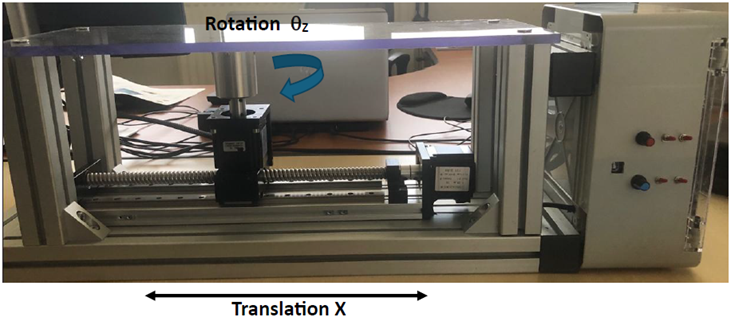 |
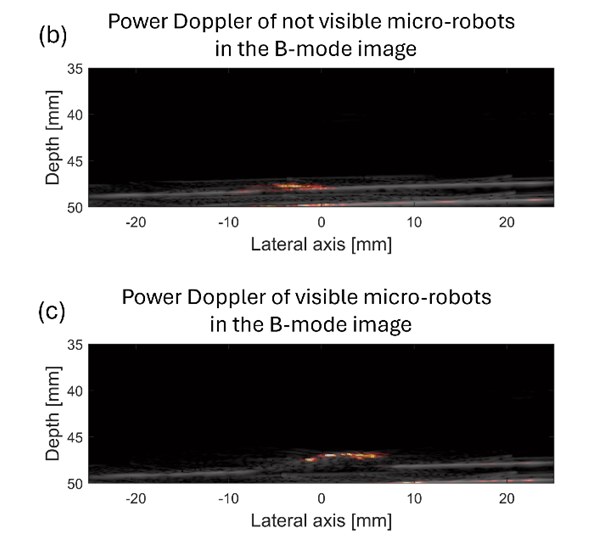 | |
Fig. 1 – (a) Picture of the robotic system to agglomerate and move the microrobots. (b-c) Preliminary imaging of microrobots with the ultrasound image in grey and the detected motion in colour. | |
In this context, we have developed, in collaboration with INSA Blois, different elementary blocks of a control validation pipeline. As shown in Fig. 1, we manufactured an external platform with two stepper motors. This platform allows us to translate the micro-robots and/or rotate them using a powerful magnet. An Arduino Uno board and external actuators control the motors. In parallel, a first imaging pipeline performs high-frame-rate imaging using a linear array and plane-wave transmissions [3]. After beamforming, motion is estimated using a specific clutter-filtering method based on singular value decomposition (SVD) [4]. Unfortunately, these two blocks are not connected and could be improved individually.
The goal of the internship is to bring these components together to create an integrated experimental pipeline: 1) Magnetic actuation, 2) Controlled motion, 3) Ultrafast ultrasound imaging and Signal processing, 4) Detection & tracking.
In summary, the aims of this internship project are:
Control the robotic platform to impose specific motion to the microrobots (lateral movement and rotation). The family of movements and their characteristic would have to be determined.
Image the microrobots using a dedicated Verasonics platform: dynamic acquisition, offline processing, segmentation… The acquired images will allow quantifying the system’s sensitivity to experimental characteristics.
Conduct a quantitative analysis of the microrobot imaging: performance of the detection/follow up of the microrobots, impact of their concentration and/or the imposed motion, effect of the imaging settings…
At the beginning of the internship, the imaging will be performed in a transparent environment. Depending on progress, we will use a dedicated vascular phantom where the microrobots can be electromagnetically fixed in the circulation.
General information
Profile: Student from a top engineering school or with a master’s degree (EEA or generalist profile)
Technical skills: Arduino, signal processing, computer science, instrumentation. Ultrasound imaging knowledge is a plus.
Soft skills: Experimental expertise, versatility and curiosity, ability to work independently, initiative, good written and oral communication skills.
Start and duration of placement: February/March 2027 for 6 months.
Workplace: Creatis, Bat Léonard de Vinci, Campus La Doua.
How to apply
Send CV + cover letter + M1/M2 or engineering school transcripts to:
François Varray, Associate Professor, francois.varray@creatis.insa-lyon.fr
Barbara Nicolas, Research Director, barabra.nicolas@creatis.insa-lyon.fr
References
[1] J. Jiang, Z. Yang, A. Ferreira, and L. Zhang, “Control and Autonomy of Microrobots: Recent Progress and Perspective,” Adv. Intell. Syst., vol. 4, no. 5, p. 2100279, May 2022, doi: 10.1002/aisy.202100279.
[2] J. Wu et al., “Motion Analysis and Real‐Time Trajectory Prediction of Magnetically Steerable Catalytic Janus Micromotors,” Adv. Intell. Syst., vol. 4, no. 11, p. 2200192, Nov. 2022, doi: 10.1002/aisy.202200192.
[3] L. Petrusca et al., “Fast Volumetric Ultrasound B-Mode and Doppler Imaging with a New High-Channel Density Platform for Advanced 4D Cardiac Imaging/Therapy,” Appl. Sci., vol. 8, no. 2, p. 200, Feb. 2018, doi: 10.3390/app8020200.
[4] C. Demené et al., “Spatiotemporal Clutter Filtering of Ultrafast Ultrasound Data Highly Increases Doppler and fUltrasound Sensitivity,” IEEE Trans. Med. Imaging, vol. 34, no. 11, pp. 2271–2285, Nov. 2015, doi: 10.1109/TMI.2015.2428634.