
 French
 English
The environmental initiative in CREATIS is led by the LIFE group (Laboratory Initiative For Environment). The group aims to raise awareness the environmental concern among the members of the laboratory, to study and improve their carbon footprint. The group is further described in the first section. The initiatives led to emission reduction measures described in the next section, as well as a computation of the carbon footprint of the laboratory, presented in the last section.
LIFE presentation
The group was created in 2021, it is a group initiated by students, but open to all members of the lab. Every year, it organises numerous awareness-raising activities, as well as concrete actions :
- several fresks : climate, digital, and food
- periodic newsletter on environmental news (whether related to research or not)
- participation in the "Ma petite planète" challenge
- poster display
- shared library of books dealing with environmental matters
- clean walk around the laboratory
- reusable cleaning equipment
- composting coffee grounds
These actions have increased interest in environmental issues within the laboratory and led to discussions and the implementation of the measures listed in the following section.
Contact : life@creatis.insa-lyon.fr
Laboratory commitments
Following its awareness-raising activities, LIFE suggested several actions that were discussed during general meetings and the executive board of the laboratory. The measures were also put to a vote during these two meetings. All of the suggested actions were accepted, they are described in the annex at the bottom of this page, and summarized here :
- commitment to reduce carbon emissions following the COP21 Paris agreements of 2015
- use local and vegetarian caterers for buffets as much as possible
- reduce IT purchases: limit the number of screens per person, extend warranties
- prohibit air travel if the journey can be made by train in less than 6 hours
- set up an individual carbon quota for scientific trips
The laboratory is also committed to calculating its carbon footprint every year. It is important to analyse how this is changing so that measures can be adapted if necessary to ensure that the desired reduction trajectory is maintained.
Carbon footprint
Methodology / Use of Labo1Point5
The various carbon footprint evaluations were carried out using the tool provided by Labo1point5. : https://apps.labos1point5.org/ges-1point5
This tool, designed for research laboratories, provides an estimate of carbon footprint based on emission factors from sources such as ADEME. These factors are subject to uncertainty, particularly with regard to purchases, due to the method used: the monetary method, which estimates the amount of carbon based on the amount and type (NACRE code) of each purchase.
Nevertheless, this is the only method currently available, and even so, it cannot yet be used for all the parent bodies of the laboratory. This method complicates the implementation of measures to reduce the ‘purchases’ item, but it does provide an order of magnitude for comparison with other emission items.
2024 Carbon footprint
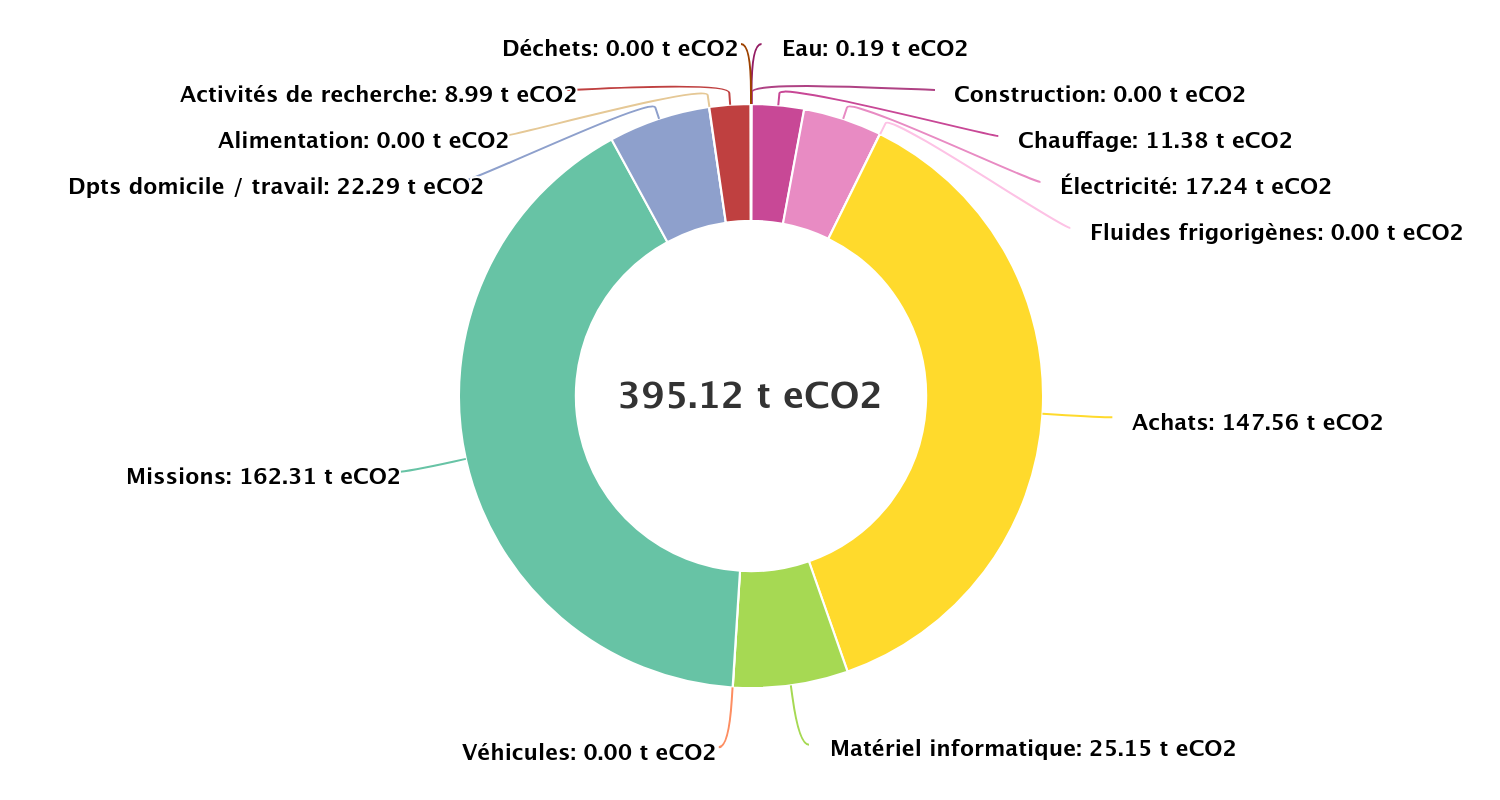
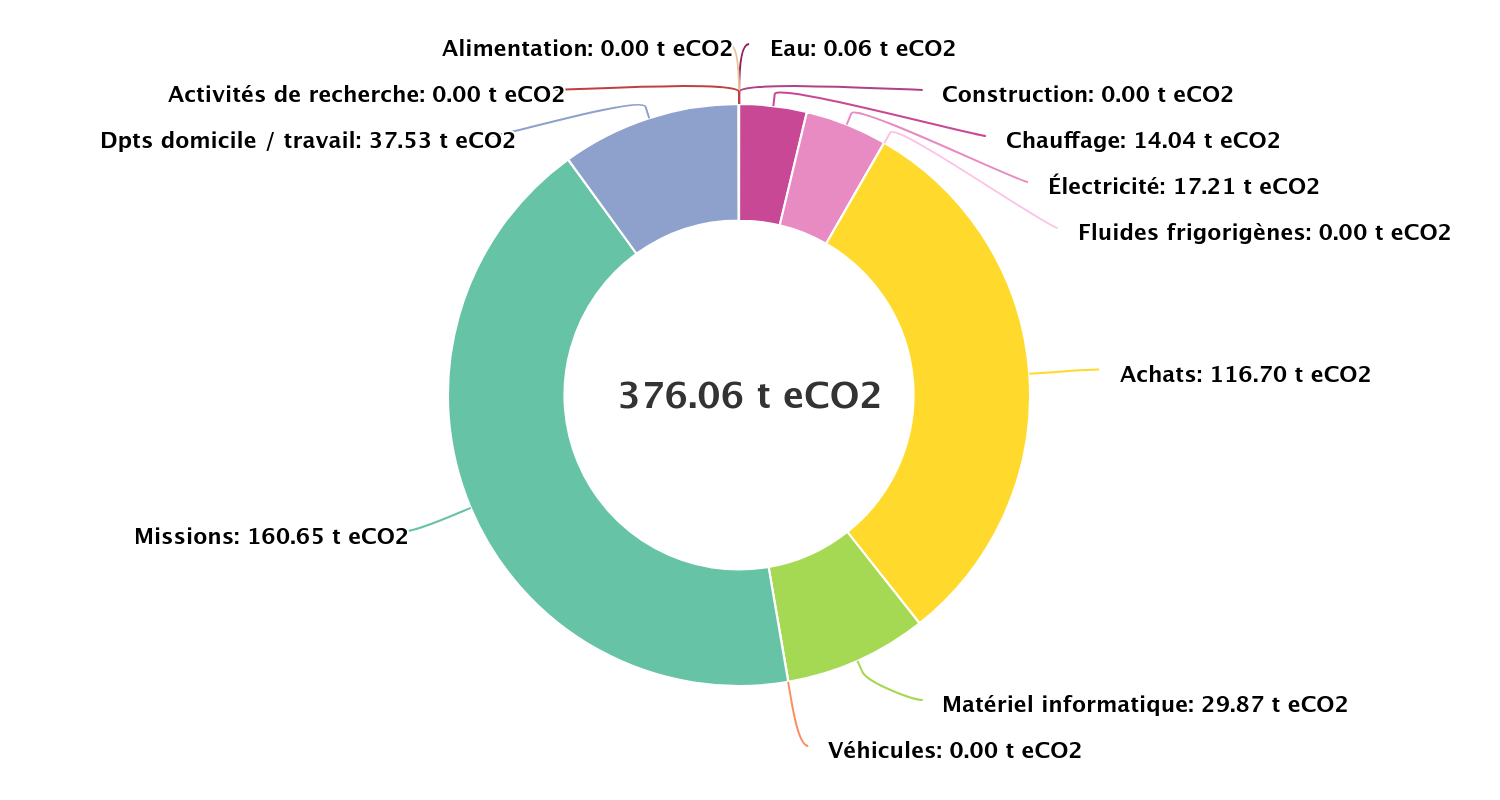
The overall volume shows an increase compared to 2023 because the scope is broader (the balance sheet for research activities is new and purchases take into account a new parent body). On a like-for-like scope, the volume is identical to 2023.
This is the first year that individual quotas have been applied to missions, but this has not led to a decrease in mission expenditure, which has risen very slightly (+2%).
2024 Carbon footprint
This is the first comprehensive carbon assessment carried out for CREATIS, providing an overview of the scale of the various emission sources. In particular, it has established that the main area where reductions could be made is scientific travel. It has therefore been voted to introduce individual travel quotas in 2024 and 2025.
Annex 1 : Details of measures voted on by the executive board
Décisions du Conseil d'Unité de CREATIS du 23 septembre 2022
Par vote, les membres du CU ont adopté toutes les mesures suivantes :
Proposition 1 : CREATIS s’engage sur le principe de réduire ses émissions de GES suivant la trajectoire proposée par les accords de Paris (i.e. réduction de 50% à l’horizon 2030).
Proposition 2 : CREATIS s’engage à calculer chaque année son bilan carbone.
Proposition 3 : CREATIS s’engage à ne faire appel qu’à des prestataires locaux et végétariens pour les buffets.
Proposition 4 : CREATIS s’engage à n’acheter qu’un seul ensemble matériel (ordinateur+écran) informatique neuf par personne si elle le souhaite. Tout membre de CREATIS souhaitant un second matériel pourra demander à en emprunter un parmi ceux disponibles au laboratoire.
NB : Le renouvellement des ordinateurs se fera, comme à l’heure actuelle, au terme de la garantie constructeur.
Proposition 5 : Les membres de CREATIS s’engagent à prendre le train pour tout trajet aller d’une durée minimale à définir.
Proposition 5 Bis : La durée minimale en train pour tout trajet aller peut être définie comme égale à 6h.
Proposition 6 : Chaque membre de CREATIS se verra doté d’un quota annuel d’émissions carbone pour l’ensemble de ses missions, défini ultérieurement au regard des données recueillies sur les missions, selon les règles suivantes :
- Ces quotas sont incessibles
- Les quotas non utilisés au cours d’une année sont transférables sur l’année suivante uniquement.
- Le suivi du quota individuel de chaque agent se fait via baserh, sans intervention d’une tierce personne. Lors de la saisie de son ordre de mission, la baserh calcule et fournit à l’agent son bilan pour ladite mission.
- Chaque agent pourra retrouver dans baserh son pourcentage d’utilisation du quota carbone pour l’année en cours.
Décisions du Conseil d'Unité de CREATIS du 15 mars 2024
Par vote, les membres du CU ont adopté toutes les mesures suivantes :
- Approbation de la mise en place d'un quota individuel de 3t de CO2 pour les mission en 2024. Il est à noter que ce quota est de 2x3t à répartir sur les années 2024-2025 avec prise en compte au 01/01/2026.
- Approbation d'une répartition d'un quota "invités" de 23t de CO2 à répartir de la même manière que les crédits d'équipe.
Il est a noté que la proposition suivante a été rejetée : Souhaitez vous qu'un quota par équipe / service soit étudié pour les années à venir.