
 French
 English
Team: MYRIAD = « Modeling & analysis for medical imaging and Diagnosis »
Supervision: Nicolas DUCHATEAU (Full Professor) - Olivier BERNARD (Full Professor)
Collaboration with:
- Sherbrooke University, Canada: Pierre-Marc JODOIN (Full Professor)
- INRIA Sophia-Antipolis, France: Maxime SERMESANT (Research Director)
-------------------------------------------
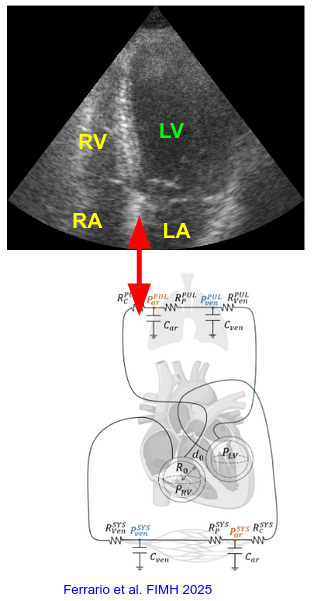
Figure: Schematic view of 0-D computational model of the heart (bottom) to be personalized on 2D echocardiographic views (top).
-------------------------------------------
Context: The segmentation and tracking of dynamic imaging sequences, such as 2D echocardiography, allows estimating myocardial shape and local deformation (strain), which allows better characterizing cardiac diseases and better identifying patients at risk. Deep neural networks led to substantial stepforwards for the automatic estimation of such quantities, but they require being trained and/or validated on large databases with ground truth. The European project SCAILED to which we contribute explicitly targets the generation of synthetic data for such purpose, and its distribution to researchers through a dedicated European data warehouse.
We have developed a unique methodology to generate large databases of synthetic images with ground truth motion [JUD-25,JUD-26], which relies on physics-based ultrasound simulation, but also on reliable shape and motion estimation. This methodology allows generating highly realistic image sequences from existing data. However, it is purely data-driven and therefore lacks physiological consistency, which is essential in the context of challenging images and reliability of the shared synthetic data.
Our collaborators have developed computational biophysical models of the heart and circulatory system, which include the different chambers and their interactions. They cover simple models for the heart circulation (also referred to as "0-D") [BAN-21,FER-25] and more advanced models up to 3D [DES-23]. For example, state variables of the 0-D model are different flows and pressures, and cardiac parameters include stiffness and contractility, to be estimated from patient data, a process referred to as "personalization".
-------------------------------------------
Objectives: The proposed project targets the incorporation of such models to improve the robustness and realism of the image generation, adding physiological consistency to the existing data-driven methodology. More specifically, we target:
- Personalization of 0-D and 3-D computational models of the heart to echocardiographic sequences from our databases.
- Improving the image simulation pipeline with more consistent displacement of the scatterers, driven by the biophysical model output.
- Extending this pipeline to pathological variants of the original data, driven by changes in the model parameters.
- Generating large datasets of synthetic images to be used for training segmentation and tracking networks.
Practical information:
• Location: DOUA campus, CREATIS lab, Villeurbanne
• Duration: 24 months, starting early 2027
• Exploratory subject in close collaboration with other researchers focusing on segmentation and tracking.
Profile:
• Candidate with PhD in machine learning and/or applied mathematics and/or computational modelling.
• Preferentially with experience on medical imaging.
• Good programming skills in Python.
• Fluent in English (reading, writing, speaking).
Contact: Send your CV and motivation / recommendation letter to: nicolas.duchateau@creatis.insa-lyon.fr
-------------------------------------------
Bibliography:
[BAN-21] Banus et al. Med Image Anal 2021;72:102089.
[FER-25] Ferrario et al. FIMH 2025.
[DES-23] Desrues PhD 2023.
[JUD-25] Judge et al. IUS 2025.
[JUD-26] Judge et al. MICCAI-STACOM 2026.