
 French
 English
Purpose and Context
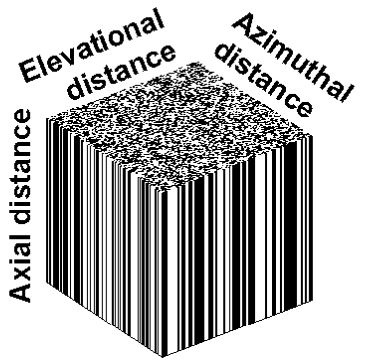
In 3D US imaging, the number of RF lines that must be acquired to sweep the whole volume can be extremely high, thus leading to low frame rate. In this context, the recently introduced compressed sensing (CS) theory offers the perspective of reducing the amount of data acquired. The objective of this study is to investigate the feasibility of compressive sensing on 3D ultrasound experimental data using a learned overcomplete dictionary and a line-wise subsampling scheme.
Method
Successful CS reconstruction implies the data should have a sparse decomposition in a basis, frame or dictionary. Thus, we use learned overcomplete data-driven dictionaries that have proven to optimally represent the US images
Conventional CS reconstruction uses random point-wise sampling. However, due to the physical constraints of the US instrumentation, this point-wise sampling is not achievable in practice. Thus, we focused on a strategy that consists in randomly skipping the acquisition of several RF lines. The main interest of this strategy relies on the fact that it is easily implementable in practice and offers the perspective of increasing the frame.
Results
For the acquisition of the volumes we use the Ultrasonix MDP research platform equipped with the 4DC7-3/40 Convex 4D transducer. The central frequency of the probe was of 5 MHz and the signals were collected using a 40 MHz sampling rate. Using this system we imaged ex vivo organs purchased from the store: 3 pig brains, 3 sheep hearts and 2 pig kidneys.
CS reconstruction was performed on a sub-sampled dataset by removing 20 to 80% of the original samples using the proposed line-wise subsampling and a point-wise sub-sampling scheme. Results based on K-SVD were compared to Fourier and DCT-based reconstruction.
Figures 1(a) and 1(b) show the reconstruction NRMSE (Normalized Root Mean Square Error) as a function of the number of removed samples for the ex vivo brain and heart US volumes. The error associated to the line-wise sampling is larger but close to the one corresponding to the point wise sampling. The K-SVD dictionary yields the smallest error, whatever the subsampling rate.
|
|
(a) | (b) |
Figure 1 : NRMSE as a function of the number of removed samples using the pointwise random sampling and line-wise sampling. The error is computed for the CS reconstruction of the ex vivo brain (a) and heart (b) using K-SVD dictionary, Fourier basis and DCT. | |
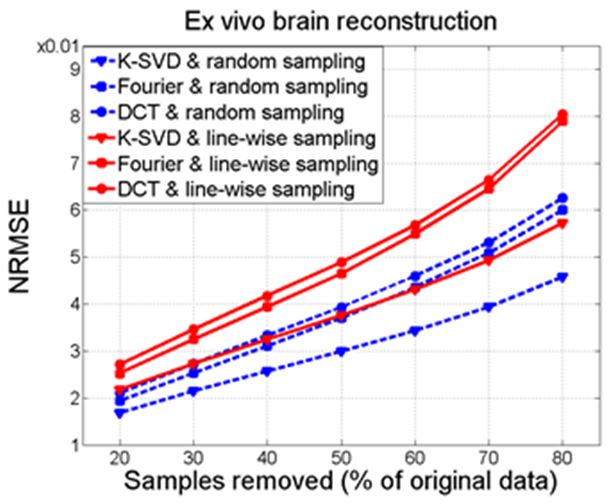
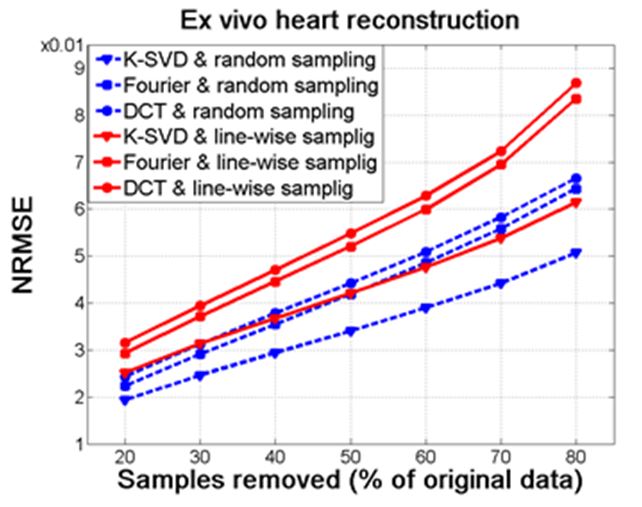
Figure 2 shows the log-envelope images corresponding to the reconstructed non-log envelope 3D US volume of the ex vivo kidney. We show only one axial-azimuthal slice on which we can see the effects of the sampling and the quality of the reconstruction. The left image represents the original data before subsampling and reconstruction followed by the CS reconstruction using the K- SVD dictionary and the CS reconstruction using the Fourier basis at 50% and 80% subsampling.
|
Figure 2: Visualization of 3D CS reconstructions of an ex vivo kidney US volume using line-wise sampling mask. Reconstructions were performed using the K-SVD dictionary and Fourier basis for 50 and 80% subsampling rates. |

Conclusion
This study thus demonstrates that CS using overcomplete learned dictionaries can be applied to experimental 3D ultrasound imaging to reduce the volume of data needed and speed up the acquisitions. High quality reconstruction can be obtained using only 50% of the initial data, potentially leading to a frame rate two times higher than the standard.