
Teaching Activities
Department of Telecommunications and FIMI first cycle
Signal processing, Systems of communication, Physical layer,
Artificial Intelligence for Vision
Module Responsibilities
- I am currently in charge of five modules, which involves designing the contents, coordinating the teaching teams, organising the assessment and running the sessions.
- MAS — Mathematics for Signal Processing (3TC, since 2025).
- TSN — Digital Signal Processing (3TC, since 2024), including the pedagogical redesign of the module in support of the SON project.
- SIS — Signals and Systems (3TC, since 2017), redesigned in 2022 into a fully active tutorial format under Matlab/Simulink with self-assessment quizzes.
- EVD — Expression, Monitoring and Debate (3TC/3TCA, since 2024), a cross-disciplinary humanities module built around press reviews and structured debates on controversial topics from technological news, with peer assessment and shared feedback.
- P2I-2 module M3.RC and project P3.1 (FIMI, since 2015), covering the physical layer of the wireless sensor network project.
- Previously in charge of SNC2 (Digital Society, Culture and Communication, 2022-2024) and CTC (Telecom and Communication Culture, 2017-2022).
Artificial Intelligence for Vision (5TC)
- In 2024 I co-created, with colleagues from CREATIS, two fifth-year options dedicated to Artificial Intelligence for Vision: the IAV course and the PRJ-IAV project.
- IAV covers state-of-the-art architectures for classification, detection, segmentation, generative models and transformers. I run the advanced practical sessions under JupyterLab (PyTorch, Ultralytics, MONAI) on transformers, segmentation, auto-encoders, variational auto-encoders and generative AI.
- PRJ-IAV is a 32-hour project in which students implement deep learning architectures in small groups. This direct transfer from research to teaching gives students access to the most recent methods in the field.
Teaching Domains in TC
- Signals and Systems
- This module provides the theoretical and methodological core to the study of telecommunications technologies. The concepts studied allow the characterization of a system. It introduces the fundamentals of signal processing. Continuous and discrete signals and systems are studied both in time and frequency domains. Convolution and correlation tools are studied. Fourier and Z transforms are presented. Linear and time-invariant systems are analyzed through their impulse and frequency responses and their transfer function.
- Signal Processing
- Sampling theorem, quantization, restitution. Digital filter features : transfer function, impulse response, differential equation, group delay, IIR/FIR.
- Communication Systems
- The course covers various aspects of OFDM, including its application in handling frequency-selective channels, ensuring orthogonality among subcarriers, performing IFFT operations, incorporating pilots for channel estimation, implementing equalization techniques, appending cyclic prefixes for signal protection, achieving synchronization using the Schmidl and Cox algorithm and correcting frequency deviations. It aims to understand the architecture of software-defined radio transmission/reception equipment.
- 1st year Research Project
- Waveforms for the 5G physical layer: which one to
choose?
Towards a fleet of autonomous and intelligent strandbeests. Motion planning, Swarm robotics, SLAM.
Exploration of the UNet and YOLO Deep Learning algorithms: evaluation and testing in medical imaging. - 2nd year Technical Project
- Constructing an MRI multimodal dataset of healthy subjects through atlas registration for fine-tuning generative AI.
Teaching Domains in FIMI
- P2i-2 : #ADC » Architecture Matérielle, Logicielle et Réseau sans fil pour les Données Capteurs
- Practical Works
- Software-Defined Radio, Physical Layer of Wireless Communications, LoRa and LoraWAN.
- Team Project
- The objective of the project is to design a complete infrastructure for wireless sensors, starting from the acquisition of physical quantities, to the design of the wireless network, and to the transmission of data for processing and analysis. In parallel with technical development, students are encouraged to consider the political, environmental, economic, and social implications of their sensor device.
Project of communication systems.
OFDM transmission Transmitter/Receiver.
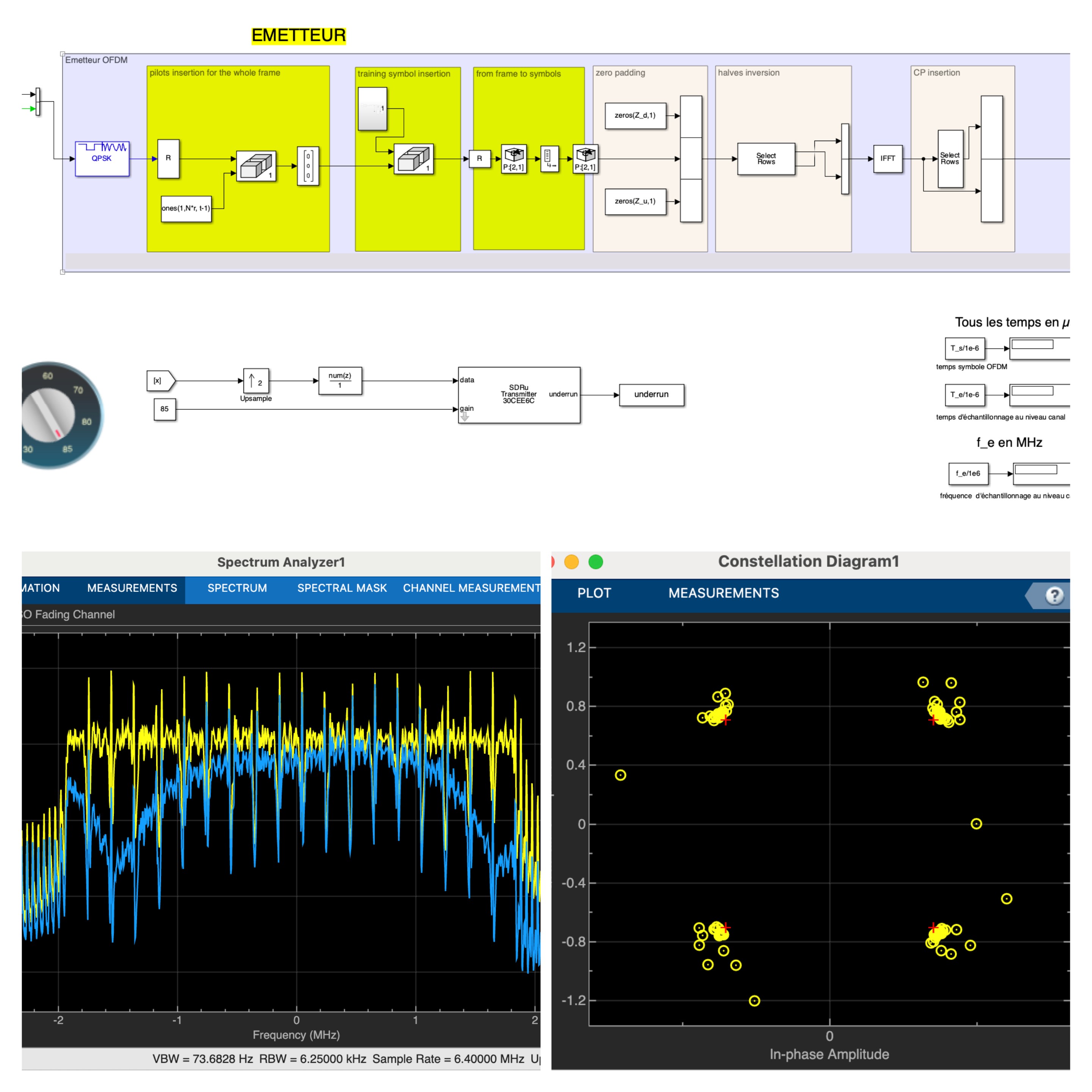
- Matlab / Simulink.
- USRP software-defined radio.
- Analysis of FSK and LoRa modulations.
- Study of synchronisation.
P2I-2 Practical work
Study of the physical layer with FSK and LoRa transmissions using the MKR 1310 board.
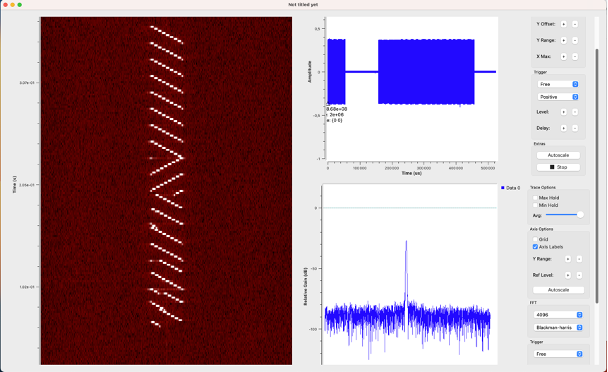
- RTL-SDR software radio.
- Gnuradio companion / Arduino IDE
- Analysis of FSK and LoRa modulations.
- Study of narrowband and baseband signals in time, frequency, and time-frequency domains.
P2I-2 Practical work
Representation of the spectrum in Waterfall Youtube Video Recording 836MHz Bouygues - DL - 4G.
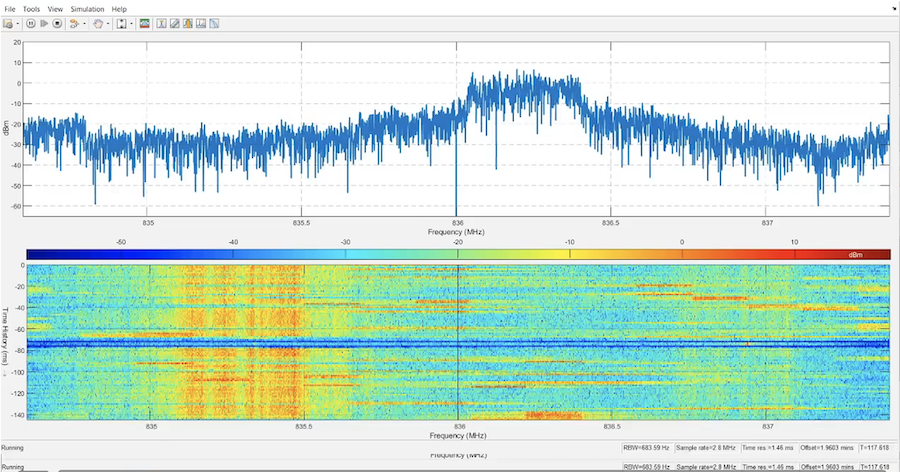
- Time-frequency study with RTL-SDR