
 French
 English
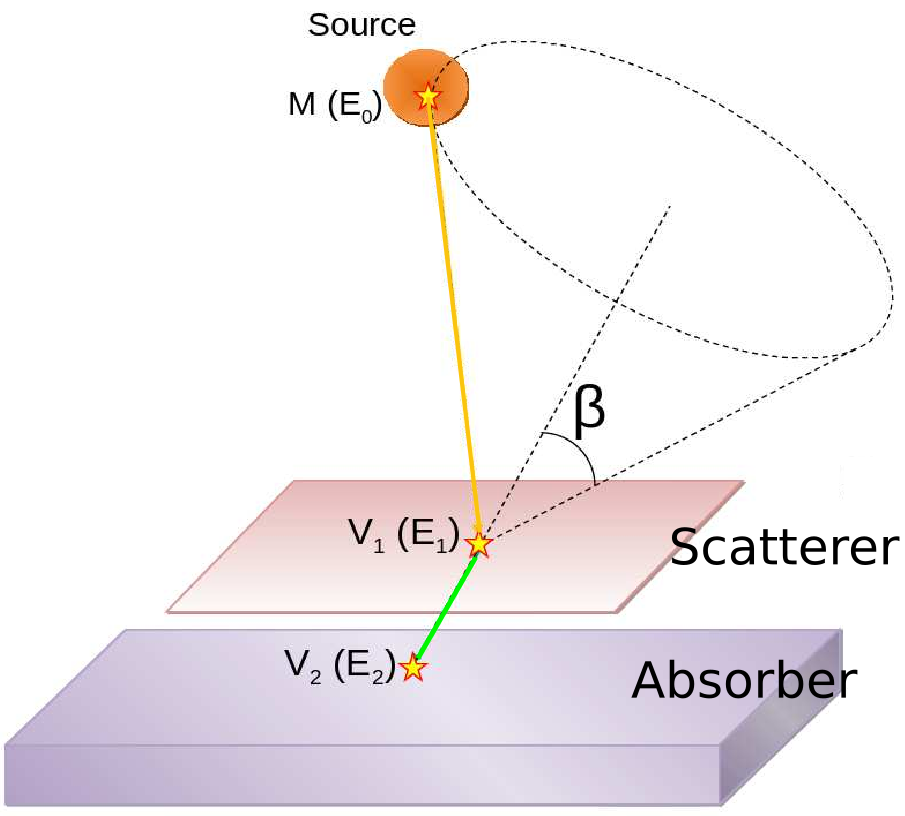
Compton cameras (CC) are experimental devices for gamma imaging, allowing counting rates and energy ranges superior to those of clinical SPECT cameras. The acquired data are modelled as Radon transforms on cones, a new research topic triggering a lot of effort in the last five years. The recent regain of interest for CCs is due to new application fields (nuclear plants, proton-therapy, multi-tracer SPECT imaging), where its best attributes are the high efficiency and its capability to produce 3D images with small and mobile devices (the limit is pushed towards hand-held prototypes).
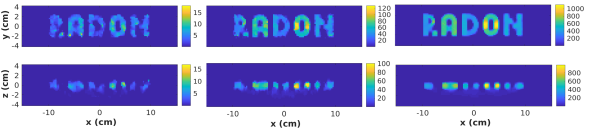
Image reconstruction is a key issue in CC development. Analytical methods could be employed for large and low-noise counting rates as they are fast and have low memory requirements [Maxim-2014-TIP], [Maxim-2019-Inverse Problems]. However, only iterative methods can cope with the data quality provided by current prototypes and with the low counting rates imposed by the applications. The sources of noise need to be modelled in the reconstruction process and regularization techniques are necessary to reduce the variance in the reconstructed images. The PhD of E. Hilaire [Hilaire-2016-PMB], [Maxim-2016-PMB] supported by INSIS and defended in 2015, was partly devoted to the study of the model and of its numerical implementation. Models for Doppler broadening and measurement uncertainties are further investigated in the PhD of Y. Feng (to be defended in 2019). Moreover, an efficient and convergent algorithm for the resolution of the TV regularized reconstruction problem with Poisson distributed data was developed and submitted for publication. The regularization has strong effect on CC images with low statistics (see figure, from left to right 2x10⁴, 2x10⁵ and 2x10⁶ ideal events) as it was shown in [Feng-IEEE NSS-MIC -2018].
All the instrumentation and image reconstruction developments are supported by Monte Carlo simulations. A new Gate module for CC simulation is currently being implemented. In a first attempt to simulate CC acquisitions from proton therapy, we employed Geant4 with the front-end MEGAlib for the CC acquisition and GATE for the treatment and gamma emission. Investigation of CC capabilities for proton-therapy monitoring have been carried out in the thesis of E. Hilaire by combining simulation and image reconstruction developments [Hilaire-2016-PMB] ( PhD price “Amis de l’Université de Lyon” 2016).